CRJ-900 Collides with Fire Truck at LaGuardia — Pilots Killed: NTSB Investigation Underway
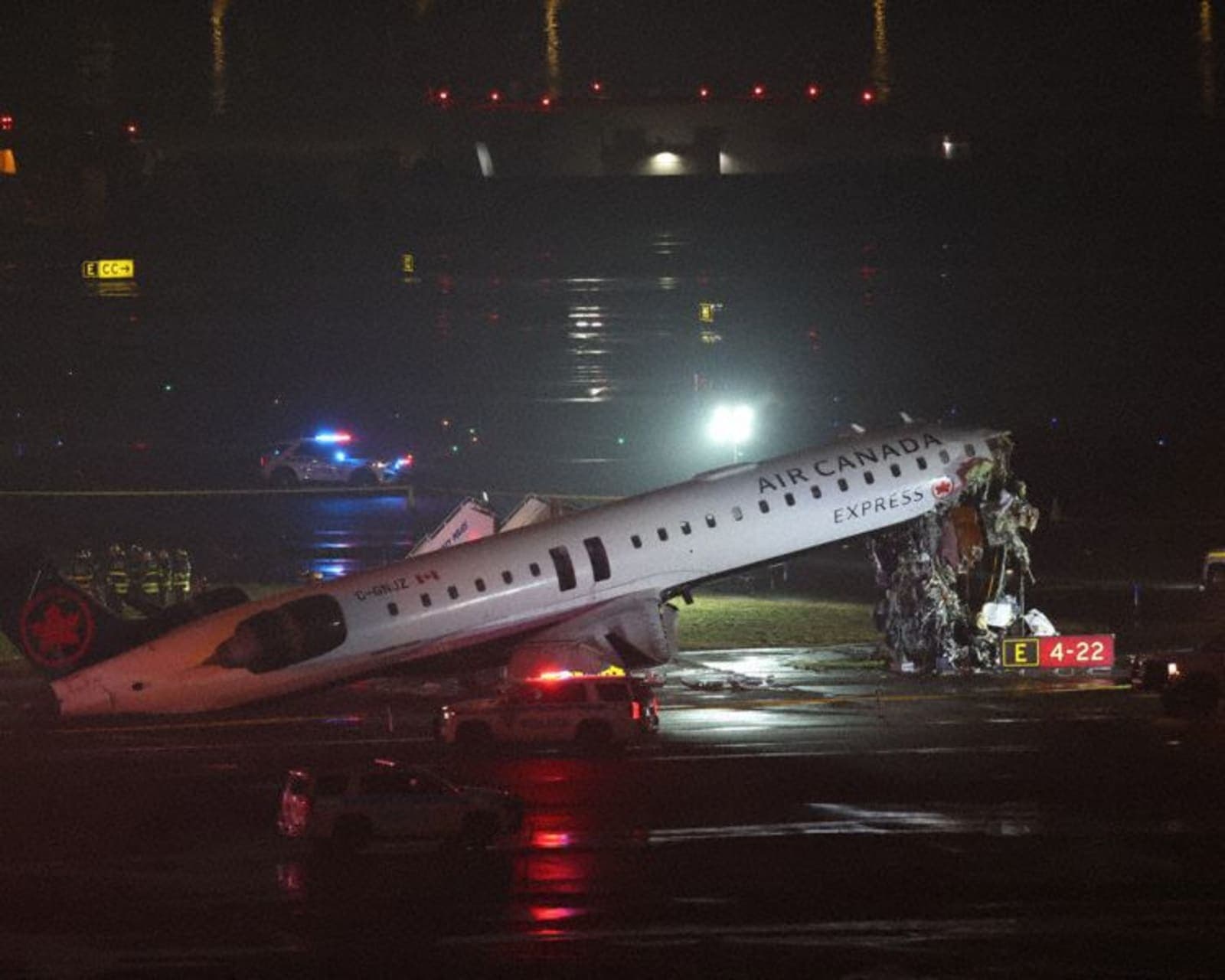
CRJ-900 Collides with Fire Truck at LaGuardia, Pilots Killed
A Preliminary Analysis of the Air Canada Express CRJ-900 Accident
A Jazz Aviation Canadair CRJ-900 aircraft, registration C-GNJZ, flying as AC8646 from Montreal, Quebec, to New York LaGuardia, was in its approach and cleared to land on Runway 04 with 72 passengers and 4 crew members.
At the same time, another emergency situation occurred with a United Airlines aircraft that reported an unusual odour. This situation prompted the airport's fire department to respond. Fire Truck #1 was cleared to cross Runway 04 at Taxiway D. Immediately thereafter, air traffic control attempted to cancel this clearance with several "STOP" commands. However, a collision occurred between the two aircraft.
At approximately 23:36 local time, the accident occurred between the CRJ-900, which had landed and was in its rollout phase, and the fire truck. Both crew members of the aircraft were killed. Two firefighters on board the fire truck received serious injuries. Among the passengers, nine received serious injuries, while 32 received minor injuries.
“"Tower, Truck 1. Stop Truck 1. Stop! Stop Truck 1, STOP!" — KLGA ATC (LaGuardia Tower Controller)”
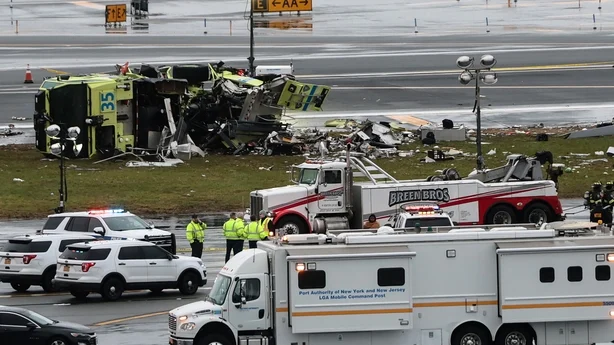
Damaged Airport Rescue and Firefighting (ARFF) truck at the intersection of Runway 04 and Taxiway E at LaGuardia Airport, following ground collision with Air Canada CRJ-900
Airport Closure and Investigation
LaGuardia Airport was closed following the accident. Initially, it was estimated that the airport would reopen at 14:00 local time on March 24. However, this was subject to the results of the investigation.
The National Transportation Safety Board (NTSB) sent investigators to the site. By the evening of March 23, the flight data recorder (FDR) and cockpit voice recorder (CVR) had been retrieved. On March 24, analysis of the two devices began in Washington, D.C.
Black Box Findings
The preliminary results show that the CVR captured over 25 hours of high-quality audio, spread over four channels, while the FDR recorded approximately 80 hours of data, covering over 400 parameters.
In the final moments of the CVR, a series of standard procedures for an approach are heard, including the extension of the landing gear, setting the flaps, and callouts during the approach. One minute before the end of the CVR, a transmission from an airport vehicle was partially cut off by a transmission from an unknown source.
Then, Fire Truck #1 asked to cross Runway 04, and it was cleared to do so. In the final moments, the sound of ground proximity warnings was heard as the plane descended. Air traffic control ordered the vehicle to stop, but it was too late — the plane had landed, followed by the impact moments later.
Six seconds before the end of the recording, control was handed over to the captain from the first officer, who was the pilot flying. The emergency procedure to cross the runway was to assist United Flight 2384, which was making multiple rejected takeoffs and reported possible fumes or smoke on board.
The investigator found that Fire Truck #1 was not equipped with a transponder and was followed by other vehicles, the number of which is unknown.
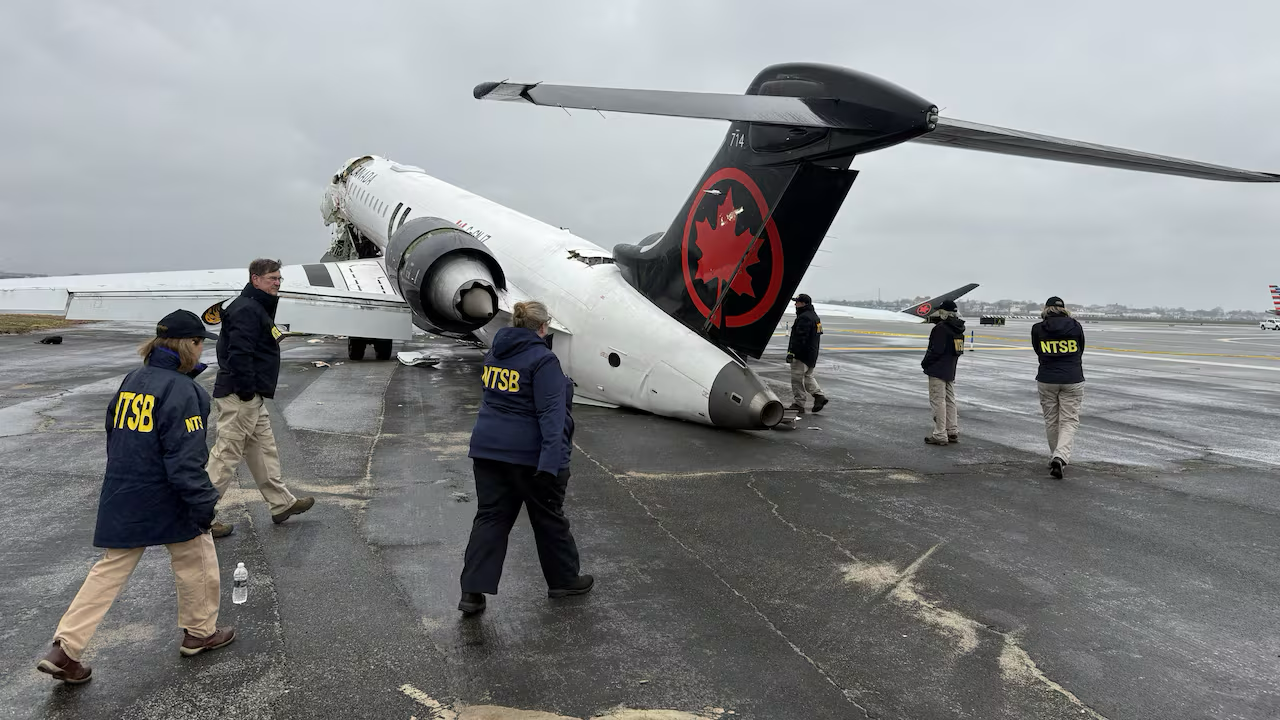
NTSB Investigator conducting on-scene examination of Air Canada CRJ-900 wreckage on Runway 04 at LaGuardia Airport (KLGA)
Air Traffic Control and Safety Systems
At the time of the accident, LaGuardia tower was being handled by two controllers — a standard procedure at midnight. One was the local controller, and the other was the controller-in-charge, who handled clearance delivery. The role of the controllers in charge of ground control at the time of the accident is unknown.
Preliminary data from the airport surface detection equipment (ASDE-X) did not reveal any targets in front of the aircraft on the runway. However, two targets were seen on Taxiway D. There were no automatic warnings, and the status lights were operational on the runway.
The NTSB continues to investigate the circumstances surrounding the accident.
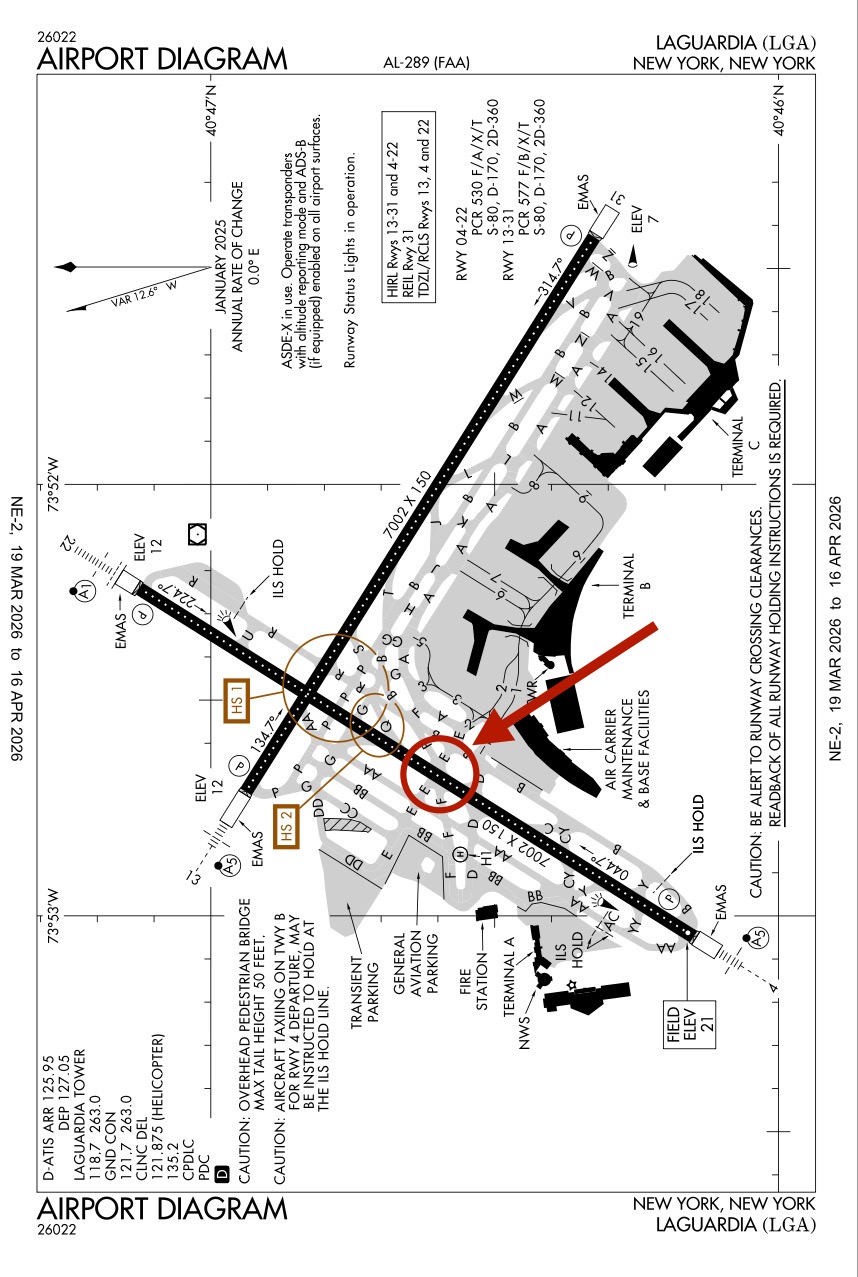
LaGuardia Airport diagram with highlighted circle showing exact collision location at intersection of Runway 04 and Taxiway E
The highlighted circle on the airport chart identifies the exact location of the collision: the intersection of Runway 04 and Taxiway E.